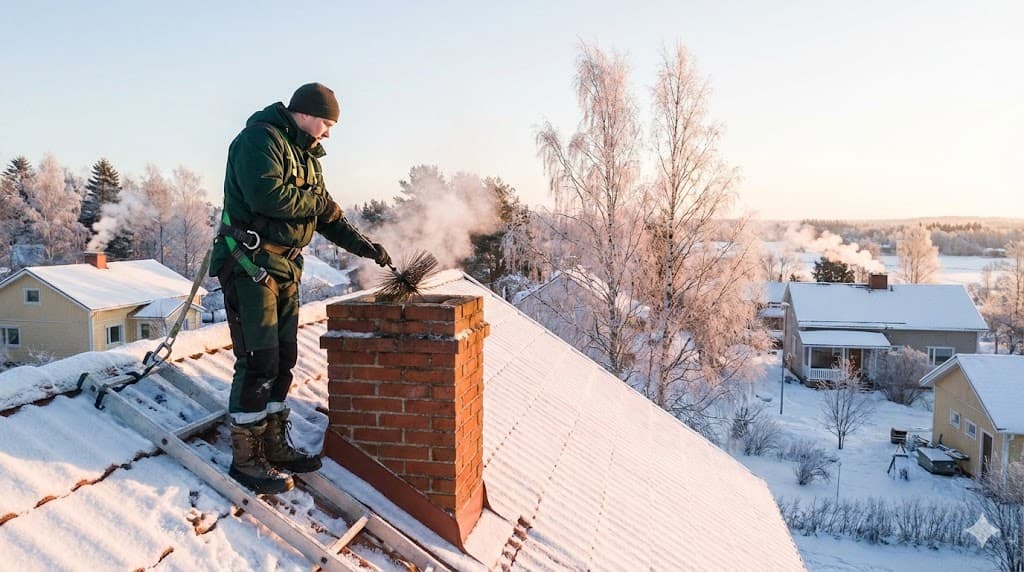
Chimney Sweeping and Fireplace Maintenance — A Complete Guide to Safe Heating
Chimney sweeping is a legal obligation in Finland and essential for fire safety. This guide covers sweeping schedules, costs, fireplace maintenance, and how to prevent chimney fires.
Illustration
- Chimney sweeping is a legal requirement in Finland for all properties with fireplaces or wood-burning stoves
- Regular sweeping every 1–3 years prevents dangerous soot buildup and chimney fires
- Professional chimney sweeping costs 60–150 euros and takes about 30–60 minutes
- Fireplace masonry should be inspected annually for cracks that could allow carbon monoxide to escape
- Proper firewood storage and burning technique reduces soot accumulation and improves efficiency
Article Summary
| Topic | chimney sweeping |
| Reading time | 11 minutes |
| Updated | 2/20/2026 |
| Author | Talon Toveri — Editorial Team |
| Suitable for | Homeowners, housing associations |
Chimney sweeping as a legal obligation
In Finland, chimney sweeping is not optional — it is a legal obligation regulated by the Rescue Act (pelastuslaki). Every property with a fireplace, wood-burning stove, sauna stove, or any solid fuel heating appliance must have its chimney professionally swept at regular intervals. Failure to comply can have serious consequences: in the event of a chimney fire or carbon monoxide incident, insurance companies may reduce or deny claims if the chimney has not been properly maintained.
The legal responsibility for arranging chimney sweeping lies with the property owner or, in the case of rental properties, whoever is designated in the rental agreement. Since 2019, homeowners in Finland have been free to choose their own chimney sweep — the old regional monopoly system was abolished. This means you can shop around for the best price and service quality, though you must ensure the sweep is professionally qualified.
A professional chimney sweep does more than just clean soot. During the sweeping visit, the sweep also performs a visual inspection of the chimney's condition, checking for cracks, deterioration, and structural issues. This inspection function is critical for fire safety and is one reason why chimney sweeping must be performed by a qualified professional, not a homeowner.
Keep all chimney sweeping receipts and documentation — they serve as proof of compliance and are essential for insurance purposes. Many homeowners keep these records in their property maintenance log alongside other service documentation.
Illustration
Sweeping schedule and frequency
The required sweeping frequency depends on how often you use your fireplace or stove. According to Finnish regulations, the intervals are as follows:
- Fireplaces and stoves used as the primary heating source (daily or near-daily use): sweeping every year
- Fireplaces and stoves used regularly but not as the primary source (weekly or more): sweeping every two years
- Fireplaces and stoves used occasionally (less than weekly): sweeping every three years
- Sauna stoves with a chimney: sweeping every three years, or annually if used frequently
In practice, most homeowners with a fireplace or wood-burning stove should schedule chimney sweeping at least every two years. If you burn wood frequently during the heating season (October–April), annual sweeping is strongly recommended regardless of the legal minimum, as soot accumulation increases significantly with heavy use.
The best time to schedule chimney sweeping is in late summer or early autumn — September is ideal. This ensures the chimney is clean and in good condition before the heating season begins. Booking early is advisable, as chimney sweeps are busiest in the September–November period. Some homeowners prefer spring sweeping after the heating season ends, which also works well and may offer better availability.
Between professional sweepings, you can monitor soot buildup yourself by shining a flashlight up through the firebox or clean-out door. If you notice thick, tar-like creosote deposits, schedule a sweeping promptly regardless of when the last one was done, as creosote is the primary fuel for chimney fires.
Chimney sweeping costs
Chimney sweeping is one of the most affordable maintenance services for your home, yet one of the most important. The typical cost for sweeping a single chimney flue ranges from 60 to 120 euros. If you have multiple flues — for example, a fireplace, a sauna stove, and a wood-burning stove each on separate flues — each additional flue adds approximately 30–60 euros to the total.
The total cost of a chimney sweeping visit typically breaks down as follows:
- Basic sweeping of one flue: 60–120 euros
- Each additional flue: 30–60 euros
- Travel surcharge (if applicable): 20–50 euros for remote locations
- Condition inspection report (if requested separately): 50–100 euros
- Creosote removal (heavy deposits): additional 50–150 euros
Many chimney sweeps offer package deals for properties with multiple flues, which can reduce the per-flue cost. It is also common for neighbors or housing cooperatives to coordinate sweeping visits to split the travel costs. Some sweeps offer discounted rates during their quieter periods (January–August), so booking outside peak season can save money.
The household tax deduction (kotitalousvähennys) applies to chimney sweeping as it qualifies as a maintenance service. You can deduct 40% of the labor cost, with a maximum annual deduction of 2,250 euros across all household services. This makes professional chimney sweeping even more affordable. Remember to pay by bank transfer or card — cash payments are not eligible for the tax deduction.
Illustration
Safe fireplace use
Using your fireplace safely is just as important as regular chimney sweeping. Proper burning technique reduces soot accumulation, improves heating efficiency, and minimizes the risk of chimney fires and carbon monoxide exposure.
Key rules for safe fireplace use:
- Use only dry, well-seasoned firewood with a moisture content below 20%. Freshly cut wood has 40–60% moisture and produces excessive smoke and creosote
- Store firewood in a covered, ventilated space for at least 1–2 years before burning
- Never burn painted, treated, or laminated wood, as these release toxic compounds
- Start fires with small pieces and gradually add larger logs — a hot, clean-burning fire produces less soot
- Ensure adequate air supply during burning. Do not close the air damper too early
- Close the damper only after the fire has completely burned down and embers have stopped glowing
- Never leave a fire unattended, especially with children or pets in the home
Carbon monoxide (CO) is an odorless, invisible gas that can be fatal. It forms when combustion is incomplete, often due to insufficient air supply or closing the damper while embers are still glowing. Every home with a fireplace should have a carbon monoxide detector installed near the fireplace area. CO detectors cost only 20–50 euros and can save lives.
During heavy use, be aware of the signs that your fireplace or chimney needs attention: smoke entering the room when lighting fires, a persistent burning smell even when the fireplace is not in use, or visible soot staining around the firebox opening. Any of these symptoms warrant immediate professional inspection.
Need professional help?
Talon Toveri's trained professionals help with all home maintenance tasks. Request a free, no-obligation quote.
★★★★★ 4.8/5 — 2,500+ satisfied customers
Assessing flue condition
The chimney flue is the internal channel through which combustion gases travel from your fireplace to the roof. Over time, flues can deteriorate due to the corrosive effects of combustion byproducts, thermal stress from repeated heating and cooling cycles, and moisture penetration from rain or condensation. A damaged flue is a serious safety hazard, as it can allow carbon monoxide to seep into living spaces or combustible materials to ignite within wall structures.
A basic flue condition assessment is performed during every professional chimney sweeping. However, a more thorough inspection — known as a chimney camera inspection — is recommended every 5–10 years or whenever problems are suspected. During a camera inspection, a specialized camera is lowered into the flue, providing a detailed view of the interior condition. This can reveal cracks, spalling mortar, liner damage, and blockages that are invisible from outside. A camera inspection costs approximately 150–300 euros.
Warning signs of flue deterioration:
- White efflorescence (salt deposits) on the exterior chimney surface, indicating moisture penetration
- Crumbling mortar joints visible from the attic space or at the chimney crown
- Staining or discoloration on walls or ceilings adjacent to the chimney
- Poor draft performance — smoke not drawing properly even in good weather conditions
- Pieces of mortar or brick found in the firebox or clean-out chamber
If significant flue damage is found, repair options include repointing mortar joints, installing a stainless steel flue liner, or in severe cases, complete chimney reconstruction. A stainless steel liner costs approximately 1,500–3,500 euros installed and is often the most cost-effective solution for older chimneys with deteriorating masonry liners.
Fireplace masonry and repairs
The masonry structure of your fireplace — including the firebox, hearth, smoke chamber, and visible facing — requires periodic inspection and maintenance. Over years of thermal cycling, masonry materials expand and contract, eventually leading to cracked mortar joints, loose bricks, and deteriorating firebrick linings. These issues are more than cosmetic — they can allow heat to reach combustible structures and gases to leak into living spaces.
Annual visual inspection of the firebox is something every homeowner can do. Look for cracks in the firebrick lining, gaps in mortar joints wider than 3 mm, and any bricks that appear loose or displaced. Check the throat damper for proper operation — it should open and close smoothly without binding. Inspect the lintel (the structural element spanning the firebox opening) for signs of cracking or sagging.
Minor fireplace repairs — such as repointing mortar joints or replacing individual firebricks — are relatively straightforward for a skilled mason and cost approximately 200–600 euros depending on the extent of work needed. It is essential to use the correct materials: standard cement mortar is not suitable for firebox repairs, as it cannot withstand the high temperatures. Refractory mortar and firebrick rated for at least 1,000 °C must be used inside the firebox.
For older fireplaces showing extensive deterioration, a complete firebox renovation may be the best option. This involves removing the damaged lining and replacing it with new firebrick and refractory mortar. A full renovation costs approximately 1,500–4,000 euros but restores the fireplace to safe, efficient operation for another 20–30 years. Always use a qualified fireplace mason for this work — improper repairs are a significant fire hazard.
Preventing and handling chimney fires
A chimney fire occurs when accumulated soot and creosote inside the flue ignite, producing temperatures that can exceed 1,000 °C. This is far beyond what the chimney structure is designed to handle and can cause the chimney to crack, damage surrounding structures, and in the worst cases, spread fire to the building. Chimney fires are one of the most common causes of house fires in Finland, with dozens occurring every year.
How to prevent chimney fires:
- Maintain the sweeping schedule strictly — the most common cause of chimney fires is excessive soot and creosote buildup
- Burn only dry, well-seasoned firewood — wet wood produces creosote at many times the rate of dry wood
- Ensure adequate combustion air — starving the fire of oxygen causes incomplete combustion and heavy creosote formation
- Avoid smoldering fires — burning small amounts of wood at low temperatures is the worst creosote producer
- Have the chimney inspected if you notice a glaze-like, dark coating inside the flue (this is stage 3 creosote and is highly flammable)
If a chimney fire occurs:
- Call emergency services (112) immediately
- Close the fireplace damper and all air inlets to starve the fire of oxygen
- Do not attempt to extinguish the fire with water — the thermal shock can crack the chimney
- Move combustible materials away from the chimney and nearby walls
- Evacuate the building if smoke or heat is detected in living spaces
- After the fire is extinguished, do not use the fireplace until a professional has inspected the entire chimney structure
After a chimney fire, the chimney must be thoroughly inspected, usually including a camera inspection, before it can be used again. Repair costs following a chimney fire range from 500 euros for minor mortar repairs to 10,000+ euros if the chimney needs to be partially or fully rebuilt. Insurance typically covers chimney fire damage, but only if sweeping has been properly maintained — one more reason to keep your chimney sweeping documentation in order.
Frequently Asked Questions
How often does a chimney need to be swept?
How much does chimney sweeping cost?
Is chimney sweeping legally required in Finland?
What are the signs of a chimney fire?
How do I know if my fireplace needs inspection?
About the author

Carlos Martinez
Property maintenance specialist
Talon Toveri's editorial team consists of experienced property maintenance professionals with over 50 years of combined experience in home maintenance and repairs. We review every article's technical content based on industry best practices.
Content verified: The content of this page has been written and reviewed by Talon Toveri's professional property maintenance team. The information is based on industry best practices and years of field experience. Last updated February 20, 2026.
Read Also
Home Maintenance Checklist
A home maintenance checklist helps you remember important maintenance tasks at the right time. Regular maintenance saves money and keeps your home value high.
DIY Drain Cleaning
A drain clog is a common problem that can often be solved with DIY methods. In this guide, we cover the most effective methods and when it's time to call a professional.
Indoor Air Quality Issues
Indoor air quality issues are common in Finnish homes. This guide helps you identify symptoms, determine causes, and find solutions for better indoor air.
Related Services
Book a professional chimney sweep easily. A chimney sweep cleans flues and fireplaces safely. Prices from €80. Book your chimney sweeping now!
Flue cleaningThorough chimney flue cleaning by professionals. Flue cleaning improves draft and increases fire safety. Prices from €120.
Fireplace masonry and repairFireplace masonry, repair, and restoration by professional masons. Building a new fireplace or restoring an old one. Prices from €500.
Chimney inspectionChimney inspection and condition assessment by a professional. Ensure the safety and functionality of your chimney. Inspection from €100. Book an inspection now!